Per Mertesacker is a German football coach and former professional centre-back best known for representing Hannover 96, Werder Bremen, Arsenal and the Germany national team. Standing 198 centimetres tall, he became one of the most recognisable defenders of his generation, combining an imposing frame with positional discipline and a measured approach to defending.
His career stretched from the Bundesliga to the Premier League, where he helped Arsenal collect major domestic honours. Internationally, he reached 104 appearances for Germany and finished as a World Cup winner. After retiring as a player, he moved into youth development at Arsenal, extending his association with the north London club.
Wikimedia Commons
Early life and youth development
Mertesacker was born in the Hanover area in 1984 and grew up in Lower Saxony. Published profiles connect his early development closely with Pattensen, a small town near Hanover. His father, Stefan Mertesacker, has been described as a youth coach at Hannover, giving the future Germany international an early connection to organised football.
Youth-career records list Mertesacker with TSV Pattensen from 1988 until 1995 and Hannover 96 from 1995 until 2003. That pathway kept him within his home region while placing him in the academy of one of northern Germany’s leading clubs. It also gave him time to develop physically and tactically before entering the senior game.
His progression was not built around the profile of an attacking prodigy. Instead, he developed as a specialist central defender. By the time he established himself at senior level, his height, defensive awareness and relatively calm use of the ball had become the defining features of his game.
Breaking through at Hannover 96
Hannover 96 provided Mertesacker with his professional breakthrough. Having advanced through the club’s youth system, he became part of the senior side and began building his reputation in the Bundesliga. His performances also introduced him to a wider national audience at a time when Germany was renewing its playing squad.
For a young defender, regular football in the German top flight offered a demanding education. Mertesacker had to deal with physical centre-forwards, mobile attackers and the tactical variety of the Bundesliga. His emergence at Hannover showed that his unusual height did not prevent him from functioning within a structured defensive line.
The club remained significant throughout his story. Hannover was not merely his first professional employer; it was the place where a locally developed player established the foundation for an international career. His subsequent move to Werder Bremen represented a step into a side competing for major honours and European places.
Werder Bremen and domestic success
Mertesacker’s move to Werder Bremen placed him in a more prominent competitive environment. He became a central defender for Bremen during a period in which the club remained an important force in German football. His time there added European experience to the Bundesliga grounding he had received at Hannover.
At Bremen, Mertesacker developed from an emerging international into an established senior defender. He was expected to organise, maintain concentration over long stretches and help his team build possession from the back. The responsibility suited a player whose strengths were based more on anticipation and positioning than on unnecessary risk.
His German club career included victory in the German Cup. That honour forms part of a trophy record that later expanded considerably in England. By the time Arsenal recruited him, he had already played for two Bundesliga clubs, featured at major international tournaments and accumulated substantial experience against high-level opposition.
Transfer to Arsenal and adaptation to English football
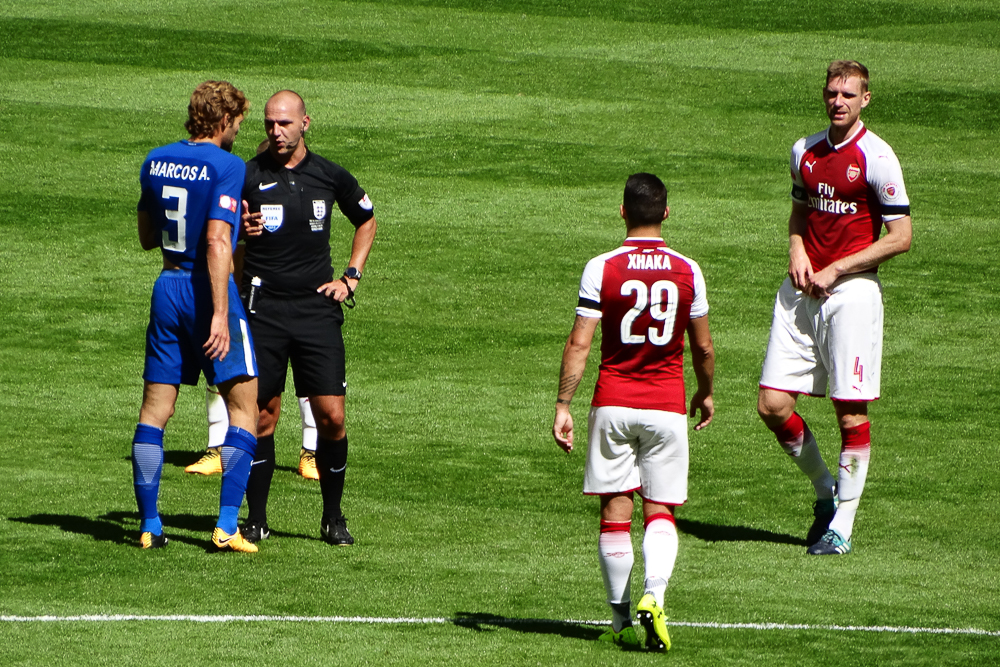
Mertesacker joined Arsenal in 2011, beginning a seven-year playing association with the club. The move required him to adapt from German football to a Premier League noted for its pace, physical contests and intense scrutiny. At 198 centimetres, he was naturally prominent at set pieces and in aerial duels, but his effectiveness could not be reduced to height alone.
His first seasons in England brought periods of adjustment. Premier League defending frequently exposes centre-backs in open space, and Mertesacker’s game depended on reading danger early rather than recovering through exceptional speed. As Arsenal developed more stable defensive partnerships, his judgement and organisation became increasingly valuable.
He also formed a strong connection with the club’s support. A 2014 report in the Evening Standard about Mertesacker’s Arsenal contract recorded his disclosure that he had supported the Gunners in childhood. That detail gave his long association with Arsenal an additional personal dimension.
Wikimedia Commons
Trophies and leadership at Arsenal
Mertesacker’s Arsenal years produced three FA Cup victories and two English Super Cup honours, commonly known as the Community Shield. The FA Cup successes were especially significant for a club seeking to turn consistent qualification and competitive performances into trophies.
His contribution was based on more than routine availability. He brought experience from Germany and international football into a squad containing players from different football cultures. His public manner was direct and analytical, while his performances reflected a willingness to accept responsibility in central defence.
Published career summaries credit him with 221 appearances for Arsenal between 2011 and 2018. Another biographical summary records 518 games across a 14-year professional career for Hannover 96, Werder Bremen and Arsenal. Statistical databases can vary because they do not always use the same competition or appearance criteria, but they consistently portray a player with extensive senior experience.
His later playing years involved less regular action, yet his standing within Arsenal remained important. He retired in 2018 rather than extending his professional career elsewhere, creating a direct bridge between his work as a senior player and his next role inside the club.
Germany international career
Mertesacker’s international record places him among a relatively small group of German players to reach a century of appearances. According to UEFA’s report on his international retirement, he ended his Germany career after 104 appearances.
He represented his country across a period of major change and increasing tournament success. Germany’s teams moved toward a more possession-oriented and technically varied identity, but Mertesacker continued to provide the traditional central-defensive virtues of structure, aerial presence and concentration.
The high point came as part of Germany’s World Cup-winning squad in 2014. Mertesacker’s final international appearance came during that tournament, after which he announced his retirement from national-team football. Ending his Germany career as a world champion gave a fitting conclusion to a long period of service.
His 104 caps are particularly notable for a centre-back, a position in which selection can depend heavily on partnerships and tactical balance. The total reflects sustained trust across qualifying campaigns, friendly matches and major competitions. Readers interested in similar careers can explore FootyBio’s international football biographies.
Playing position and defensive style
Mertesacker played primarily as a centre-back and was right-footed. At 198 centimetres and approximately 89 kilograms, according to FBref’s player record, he possessed the physical dimensions expected of an aerially strong defender. His approach, however, was generally built around decision-making rather than constant physical confrontation.
He sought to keep an organised position, identify danger early and make straightforward interventions. That method could be especially effective when paired with a quicker or more aggressive defensive partner. Instead of chasing every movement, he often protected space, held the line and attempted to guide attackers away from the most dangerous areas.
His size made him a natural target at attacking set pieces as well as a defensive presence in his own penalty area. Yet he was never principally known as a goalscoring defender. The wider value of his game lay in reliability, communication and an ability to operate within collective defensive systems.
Mertesacker also spoke openly about the pressure associated with elite football. Deutsche Welle reported on the praise and criticism generated by his discussion of the psychological strain he had felt during his career. Those reflections complicated the image of the unflappable senior professional and offered a candid perspective on the demands placed upon international players.
Retirement and Arsenal academy work
When Mertesacker ended his playing career, he moved into a coaching and development position at Arsenal’s academy. The transition was announced before he hung up his boots, allowing the club to retain his experience and understanding of professional standards.
Academy leadership differs considerably from first-team defending. The role involves helping young players handle education, personal development, technical coaching and the pressure attached to a possible professional career. Arsenal’s own account, “Per Mertesacker: In my own words”, provides insight into his experiences and the club’s player-care environment.
Arsenal subsequently announced that Mertesacker would step down as academy manager at the end of the relevant season after eight years in the position. Because coaching appointments can change, descriptions of his present employment should always be checked against the latest official information.
Career achievements and legacy
- World Cup winner with Germany.
- 104 senior international appearances before retiring from international football.
- Three-time FA Cup winner with Arsenal.
- Two-time English Super Cup or Community Shield winner with Arsenal.
- German Cup winner during his Bundesliga career.
- Senior player for Hannover 96, Werder Bremen and Arsenal.
- Arsenal academy manager after retiring from professional football.
Mertesacker’s legacy rests on longevity, international achievement and the ability to adapt. He travelled from the Hannover youth system to the Bundesliga, became a senior Germany international and then established himself in English football. His career challenged the assumption that every successful Premier League defender required outstanding recovery speed; anticipation, positioning and collective discipline could be equally decisive.
His post-playing work added another dimension. Rather than leaving Arsenal after retirement, he applied his experience to the development of younger footballers. That continuity made him more than a former overseas signing: he became part of the club’s institutional structure and an influence on the generation following his own.
Frequently asked questions
What position did Per Mertesacker play?
Per Mertesacker played as a centre-back. He was a right-footed defender known for his height, positioning, aerial presence and organisational qualities.
Which clubs did Per Mertesacker represent?
Per Mertesacker played senior football for Hannover 96, Werder Bremen and Arsenal.
How many times did Per Mertesacker play for Germany?
Per Mertesacker made 104 senior appearances for Germany before retiring from international football in 2014.
Did Per Mertesacker win the World Cup?
Yes. Per Mertesacker was part of the Germany squad that won the 2014 FIFA World Cup.
How many FA Cups did Per Mertesacker win with Arsenal?
Per Mertesacker won three FA Cups during his playing career with Arsenal.
What did Per Mertesacker do after retiring as a player?
After retiring in 2018, Per Mertesacker moved into youth development as Arsenal’s academy manager.
Research note
Biographical databases sometimes differ over dates, appearance totals and the competitions included in career statistics. Readers should cross-check important factual information with official club, competition and federation records, particularly for current appointments or other details that may change over time.