Bastian Schweinsteiger is a former Germany midfielder whose career connected Bayern Munich’s domestic dominance, a Champions League triumph and Germany’s 2014 World Cup victory. Born on 1 August 1984 in Kolbermoor, Bavaria, he developed from a wide player into an influential central midfielder and became one of the defining German footballers of his generation.
Most closely associated with Bayern, Schweinsteiger later represented Manchester United and Chicago Fire. His career was distinguished by adaptability, competitive commitment and sustained success at club and international level. Bayern’s own Hall of Fame describes him as a club legend, reflecting an association that stretched from his youth development to the peak of European football.
Wikimedia Commons
Early life and development in Bavaria
Schweinsteiger was born in Kolbermoor, then in West Germany, and grew up in the football culture of Upper Bavaria. His early development ultimately brought him into Bayern Munich’s youth system in 1998. That move placed him within the structure of Germany’s most successful club and began an association with Bayern that lasted for approximately 17 years.
The length of that relationship is important to understanding his standing in Munich. Schweinsteiger was not an established star recruited to complete a powerful team; he progressed through the club’s system before reaching senior football. Bayern’s official profile highlights both his Upper Bavarian background and his committed performances, qualities that helped make him strongly identified with the club.
His senior Bayern career began in 2002. Although detailed accounts of individual youth matches and his precise first-team debut are not included in the available research, the wider timeline is clear: he moved from Bayern’s development pathway into a first team that expected to challenge for major trophies every season.
Breaking through as a wide midfielder
Early in his professional career, Schweinsteiger was used as a winger. That role made use of his ability to operate in wider areas, but it did not ultimately define him. As his career developed, he moved inside and became primarily associated with central midfield, the position listed by Bayern, ESPN, Chicago Fire and statistical reference sources.
The transition demonstrated a central feature of his career: tactical adaptability. Playing wide and playing centrally require different positional responsibilities. A winger is generally asked to offer width and progress attacks from the flank, while a central midfielder must read pressure from several directions, support possession and understand when to advance or protect the space behind the ball.
Schweinsteiger’s evolution allowed him to contribute in several phases of a match rather than being limited to a single attacking lane. At 1.83 metres, he also had the physical presence to compete in crowded midfield areas. Over time, his identity became less about traditional wing play and more about control, work rate and responsibility in the centre.
Bayern Munich career and domestic dominance
Schweinsteiger’s Bayern senior career ran from 2002 to 2015. Those 13 first-team years formed the central chapter of his biography and explain why he is included in the club’s official Hall of Fame. Supporters came to regard him as a figure who represented continuity across different Bayern teams, managers and tactical systems.
The honours record was exceptional. Career summaries from FBref and Transfermarkt credit Schweinsteiger with eight German league championships. Transfermarkt’s achievements record also lists seven German cup victories. Those totals place him among the most decorated players of his era in the Bundesliga.
Repeated domestic success should not be reduced to a simple medal count. Remaining important at Bayern meant competing for a position in a squad continually reinforced with leading players. Schweinsteiger’s ability to move from the flank to central midfield helped him retain his relevance as the team changed around him.
His significance is also reflected in individual recognition. FBref and Transfermarkt list him as Germany’s Footballer of the Year in 2013. That honour arrived during the defining period of his Bayern career, when the club combined domestic supremacy with success on the European stage.
The 2013 Champions League triumph
The major European prize in Schweinsteiger’s club career was the 2012–13 UEFA Champions League. Bayern’s victory gave him the continental title that stands at the centre of his club legacy and completed an extraordinary season for the Munich side.
For Schweinsteiger, the Champions League success represented the peak of a long development within one institution. He had entered Bayern’s youth system in 1998, reached the senior side in 2002 and, more than a decade later, became a European champion with the same club. That progression gives the achievement a different character from a short-term move to an already successful team.
Transfermarkt’s honours summary also credits him with a UEFA Super Cup. Alongside his league and cup medals, the European trophies confirmed that his success was not confined to German competition. Readers interested in other careers shaped by Europe’s leading club tournament can explore FootyBio’s Champions League biographies.
Germany career and the World Cup
Schweinsteiger’s international reputation developed alongside his Bayern career. FIFA’s retrospective description presents him as a breakout figure at the 2006 World Cup and, eight years later, a World Cup champion. The progression from emerging home-tournament player to senior member of a title-winning side mirrors his development at club level.
The 2014 World Cup victory is the defining achievement of his international career. Germany won the tournament, and Schweinsteiger added football’s most prestigious national-team trophy to the Champions League and domestic honours he had already collected with Bayern.
His international career extended beyond one successful tournament, but the supplied material does not provide a sufficiently consistent appearance-and-goal breakdown to reproduce exact Germany totals here. What can be stated firmly is that he represented Germany over a substantial period, appeared at the 2006 World Cup, became a world champion in 2014 and later announced the end of his international career. Contemporary coverage from Fox Sports reported Schweinsteiger’s retirement from Germany duty.
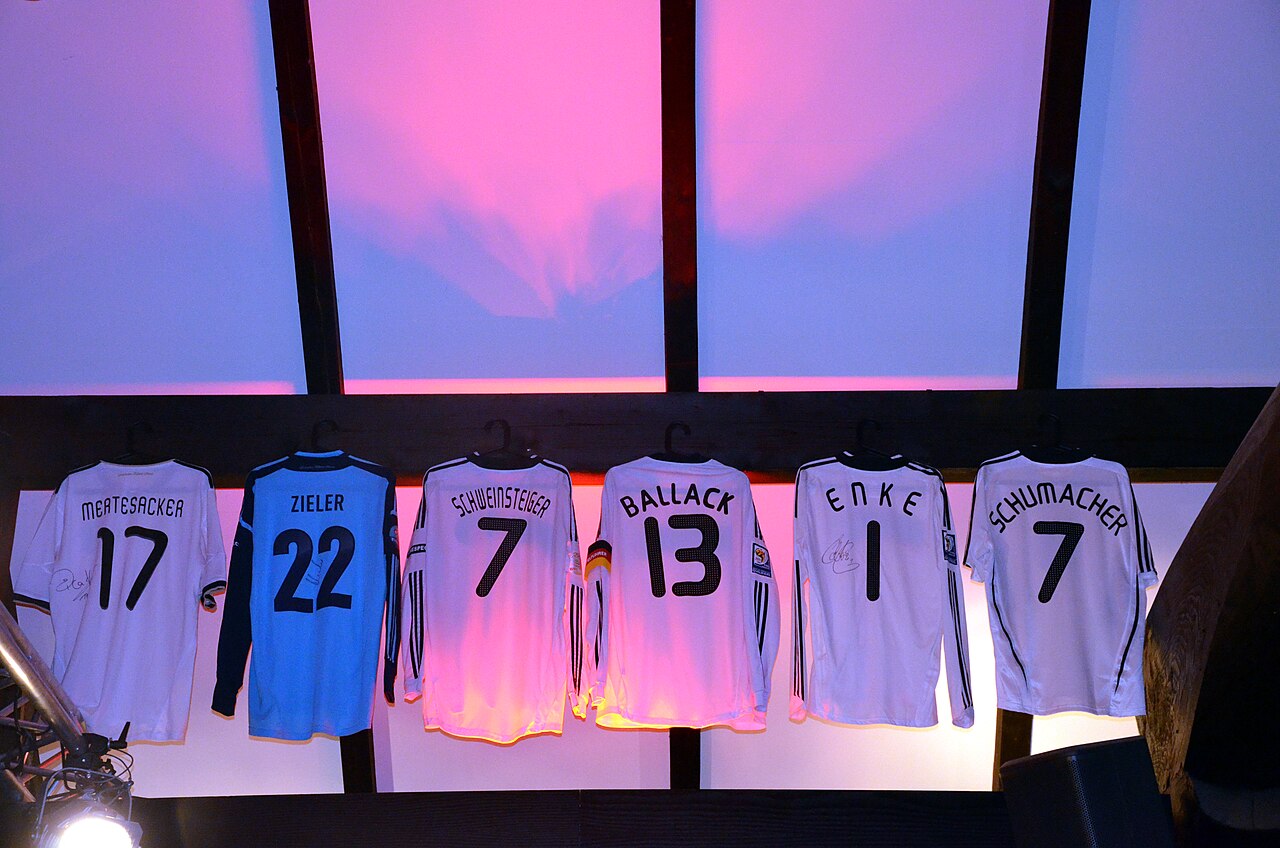
His place in Germany’s modern football history rests on that full arc: emergence, sustained involvement and eventual world championship success. His former international teammate Per Mertesacker was another prominent member of the German generation that reached the summit in Brazil.

Wikimedia Commons
Manchester United and the Premier League
Schweinsteiger left Bayern in 2015 and joined Manchester United, ending the club relationship that had defined his development and most successful years. The move introduced him to English football after his long Bundesliga career.
His Premier League record was relatively brief. The league’s official player profile lists 18 appearances, one goal and no assists in the competition. Those figures concern Premier League matches rather than every fixture he played for Manchester United, an important distinction when comparing statistical summaries from different databases.
The move nevertheless formed a notable late-career chapter. Schweinsteiger arrived in England as an experienced Champions League and World Cup winner, but his time at United did not approach the duration of his Bayern career. His status therefore remains far more closely linked with Munich and Germany than with Manchester.
Chicago Fire and the end of his playing career
After Manchester United, Schweinsteiger moved to Chicago Fire in Major League Soccer. Chicago’s official profile listed him as a midfielder, while MLS also identified him with the number 31 and recorded his involvement with the MLS All-Stars.
The United States became the final stage of his club career. For Chicago, his presence brought the experience of a player who had won the Bundesliga, Champions League and World Cup. For Schweinsteiger, MLS offered a different football environment after spending nearly all of his senior European career at two historically prominent clubs.
Career records identify Chicago Fire as his last club and list him as a retired footballer. His club journey can therefore be summarised in three senior destinations: Bayern Munich, Manchester United and Chicago Fire. The contrast is striking—an exceptionally long formative and first-team association with Bayern, followed by shorter closing chapters in England and the United States.
Playing position and style
Schweinsteiger’s career is best understood through his positional evolution. He began as a wide midfielder or winger before becoming a central midfielder. That move inward demanded greater awareness of the match as a whole and allowed him to become more involved in the organisation of possession.
His profile combined technical and physical qualities rather than relying exclusively on one speciality. He could participate in build-up play, carry responsibility in central areas and compete with the commitment praised in Bayern’s official Hall of Fame account. His earlier experience in wide positions also gave him an understanding of how central and flank players could connect.
It would be misleading to define him simply as an attacking playmaker or a purely defensive midfielder. His value lay partly in his capacity to perform several midfield functions and adapt to the needs of different teams. That versatility supported his longevity at Bayern and helped him contribute to Germany across multiple tournament cycles.
Honours, recognition and legacy
- FIFA World Cup winner with Germany in 2014
- UEFA Champions League winner with Bayern Munich in 2012–13
- Eight-time German league champion
- Seven-time German cup winner
- UEFA Super Cup winner
- Germany’s Footballer of the Year in 2013
Schweinsteiger’s legacy is founded on more than the breadth of that honours list. He was a locally rooted Bayern youth player who remained long enough to become one of the club’s defining modern midfielders. His development from winger to central figure also made his career a study in adaptation rather than simply early promise fulfilled.
At international level, his story is inseparable from Germany’s journey between the 2006 and 2014 World Cups. At club level, the 2013 Champions League stands beside eight German championships as evidence of sustained collective success. Bayern’s decision to place him in its Hall of Fame provides the clearest institutional statement of his importance.
Schweinsteiger belongs comfortably among the players covered in FootyBio’s Football Legends archive. His career connected local identity, elite club football and international achievement, while his positional development showed how an adaptable midfielder could remain influential through changing tactical eras.
Frequently asked questions
Where and when was Bastian Schweinsteiger born?
Bastian Schweinsteiger was born on 1 August 1984 in Kolbermoor, Bavaria, which was then in West Germany.
Which clubs did Bastian Schweinsteiger play for?
Bastian Schweinsteiger played senior club football for Bayern Munich, Manchester United and Chicago Fire.
What position did Bastian Schweinsteiger play?
Bastian Schweinsteiger was a midfielder. He played as a winger early in his Bayern career before becoming primarily associated with central midfield.
Did Bastian Schweinsteiger win the Champions League?
Yes. Bastian Schweinsteiger won the 2012–13 UEFA Champions League with Bayern Munich.
Did Bastian Schweinsteiger win the World Cup?
Yes. Bastian Schweinsteiger was part of the Germany team that won the FIFA World Cup in 2014.
How many Bundesliga titles did Bastian Schweinsteiger win?
Bastian Schweinsteiger is credited with winning eight German league championships during his Bayern Munich career.
Research note
This biography has been compiled from the cited club, league and reference sources. Readers should cross-check important biographical and statistical information with official records, particularly current or changing details and figures that may be classified differently across competitions.